Open Shelves, Clear Signal: Style Storage Without Visual Noise
Open shelves communicate everything at once. They show what is stored, how often it is used, and whether the room has any visual pause. This is why adding attractive objects alone rarely fixes a noisy shelf. The real work is deciding what the shelf should say and how quickly that message can be understood.
A useful shelf can still hold ordinary things. The goal is not a showroom composition. It is a visible system where daily objects remain accessible without every object demanding equal attention.
Give the unit a primary purpose
Decide whether the shelves mainly store books, support dining, hold living-room media, or display a collection. Secondary uses are possible, but one purpose should dominate. A unit that stores office files, wine glasses, children’s toys, plants, souvenirs, and spare cables will struggle to feel coherent because its categories have no relationship.
Remove items that belong to another room or need protection from dust. Open storage is best for objects that are used, enjoyed, or easy to clean.
Edit by category, not by appearance
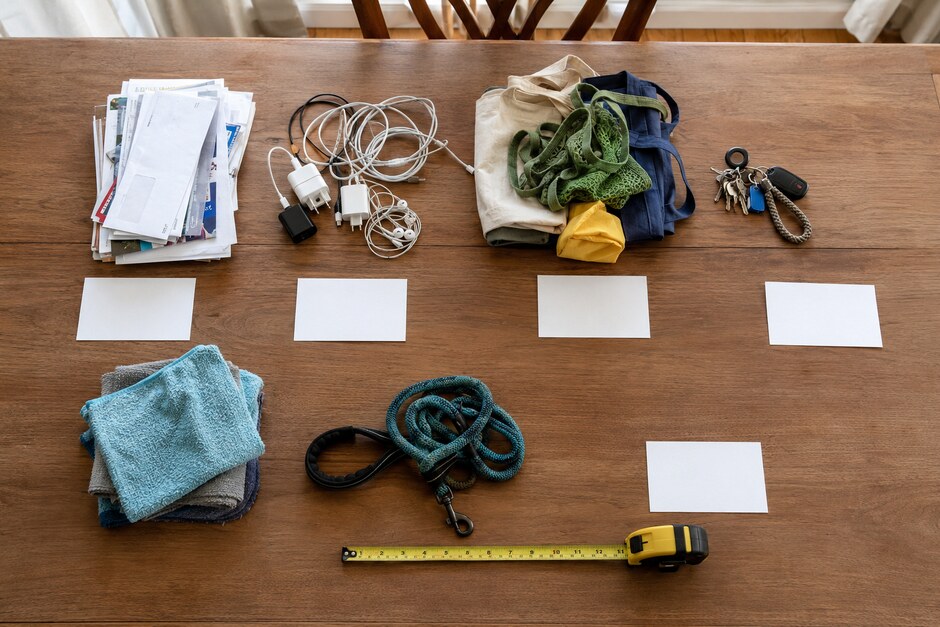
Take everything down and group it on the floor or table: books, ceramics, paper, electronics, plants, personal objects, and containers. Reduce duplicates and relocate items with no clear reason to stay.
This prevents a common mistake: moving clutter into prettier arrangements while keeping the same volume. The shelf becomes calmer when the number of active categories falls.
Establish visual weight from the bottom up
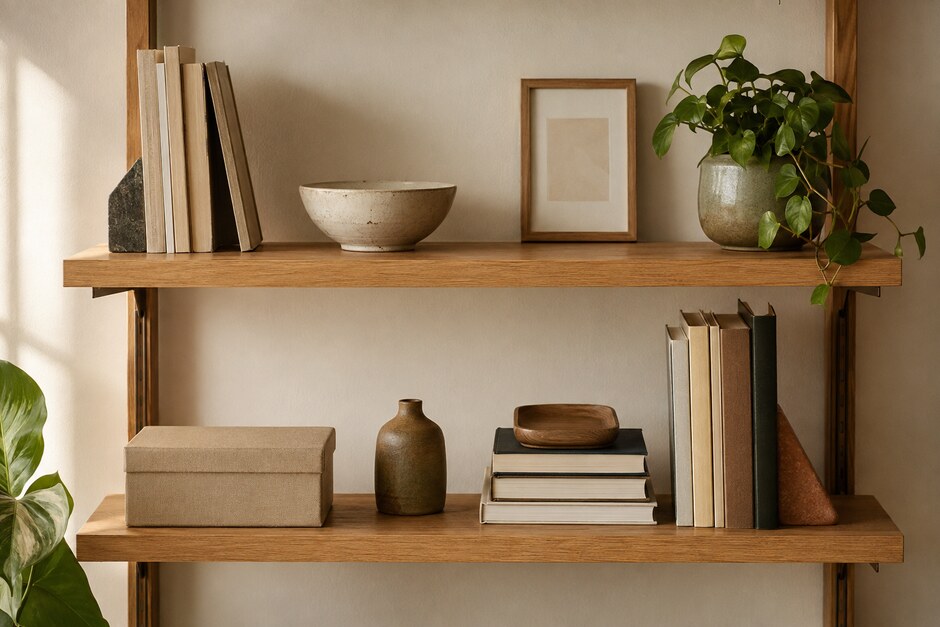
Large books, closed boxes, and heavy ceramics usually feel stable on lower shelves. Lighter objects and open forms can sit higher. This is not a rigid law, but a useful starting point. When the densest objects are concentrated at eye level or at the top, the unit can appear unstable.
Distribute dark colours rather than placing them all on one side. A small dark object on an opposite shelf can visually connect a large dark group without creating symmetry.
Group objects into readable units
The eye reads a stack of three books with a bowl as one group, but five isolated small objects as five separate signals. Combine related items and vary the footprint of each group. Some shelves can hold one wide arrangement; others can hold two smaller groups separated by open space.
Use trays or boxes when several practical items need to act as one unit. Choose containers for fit and access before colour. A lid is useful for rarely handled objects but irritating for something used every day.
Make negative space intentional
Empty shelf is not wasted storage. It separates categories, reveals the outline of objects, and leaves room for the collection to change. Aim for visible gaps around groups rather than a thin unused strip at the end of every shelf.
Stand across the room and squint. Dense areas will merge into large blocks. If all blocks have the same size and spacing, the unit can feel mechanical. If one block overwhelms the rest, reduce it or echo a small part elsewhere.
Use books as books
Arrange books so they remain easy to identify and remove. Long horizontal stacks may look composed, but they make the bottom volume difficult to access. Use a small stack to change height, then keep most regularly read books vertical.
Turn only a few covers outward when they are genuinely meaningful. Too many face-out books make a home shelf resemble a shop display and consume useful depth.
Keep maintenance visible
Leave enough space to dust without dismantling the entire arrangement. Plants need access for watering, and trailing leaves should not hide switches or damage books. Cables should follow one discreet route rather than disappearing behind several objects.
Photograph the finished shelf, then live with it for two weeks. Return objects that were missed and remove decorative pieces that became obstacles. A successful open shelf is not frozen. It provides a clear structure that can absorb daily use without immediately returning to visual noise.